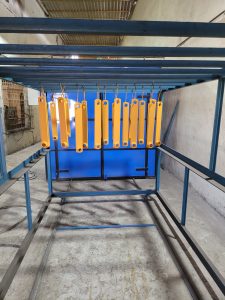
Powder coating is a dry finishing process that has become extremely popular. Representing over 15% of the total industrial finishing market, the powder is used on a wide array of products. More and more companies specify powder coatings for a high-quality, durable finish, allowing for maximized production, improved efficiencies, and simplified environmental compliance. Used as functional (protective) and decorative finishes, powder coatings are available in an almost limitless range of colors and textures, and technological advancements have resulted in excellent performance properties.
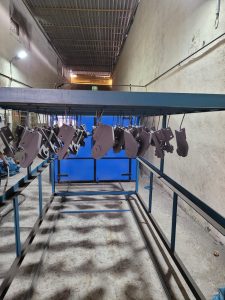
Powder coating is a high-quality finish found on thousands of products you come in contact with each day. Powder coating protects the roughest, toughest machinery as well as the household items you depend on daily. It provides a more durable finish than liquid paints can offer, while still providing an attractive finish. Powder-coated products are more resistant to diminished coating quality as a result of impact, moisture, chemicals, ultraviolet light, and other extreme weather conditions. In turn, this reduces the risk of scratches, chipping, abrasions, corrosion, fading, and other wear issues
- Grinding
Grinding refers to the process of smoothing out a substrate’s surface with tools or machines. Depending on the requirement of the product, different levels of smoothness can be achieved. Substrates are sometimes ground down to reach the required functional dimensions. It is also common for parts to undergo grinding and other pre-treatment before surface coating or anodizing. - Polishing
Polishing refers to the cleaning and smoothing of the surfaces of a substrate, to achieve a glossy, decorative finishing. Often metal substrates are polished before electroplating or coating to achieve finer finishing. - Tumbling
Tumbling, also known as barrel polishing, is mainly employed as a deburring process. A matt to glossy finish can be achieved, depending on the polishing medium applied.
Anodizing stands as an electrolytic passivation method employed to augment the oxide layer’s thickness on the surface of metal components. While sulfuric acid electrolytes are commonly used, alternative acids like chromic acid and organic acid yield distinct outcomes. Anodized components are frequently dyed or sealed to enhance durability and achieve the desired aesthetic. While the technique is commonly applied to aluminum parts, it can be extended to various metals.
This process serves several purposes:
- Enhances resistance to corrosion
- Improves resistance to wear and abrasion
- Augments surface hardness
- Establishes an electrically insulated coating
- Creates a base layer for painting or other finishing treatments
- Offers decorative finishing
Hard Anodizing, also known as Type III anodizing in the US, involves producing coatings thicker than 25 μm (0.001 inches) up to 150 μm (0.006 inches). This process utilizes sulfuric acid electrolytes, employing lower temperatures and higher voltages to achieve a thicker and harder anodized layer.
Advantages of Hard Anodizing:
- Exceptionally durable with an extremely hard surface
- Improved resistance to corrosion and wear
- Eliminates the need for sealant applications
Disadvantages of Hard Anodizing:
- Surfaces may be rougher in texture
- Cosmetic properties are less visually appealing
- Thick anodized layers may impact the functional dimensions of a part
- Color consistency within a batch can be challenging to control
Hard Anodizing is a preferred choice for parts requiring superior corrosion and wear resistance, particularly when cosmetic appearance is of lesser concern. This process is highly recommended for heavy-duty industrial equipment exposed to challenging environmental elements. For detailed specifications on our anodizing processes, please contact our Sales Department.
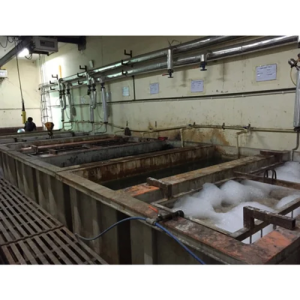
Electroplating is the process of plating one metal onto another by hydrolysis, most commonly for decorative purposes or to prevent metal corrosion. There are also specific types of electroplating such as copper plating, silver plating, and chromium plating. Electroplating allows manufacturers to use inexpensive metals such as steel or zinc for the majority of the product and then apply different metals on the outside to account for appearance, protection, and other properties desired for the product.
Electroplating, also known as electrochemical deposition or electrodeposition, is a process for producing a metal coating on a solid substrate by reducing cations of that metal by means of a direct electric current. The part to be coated acts as the cathode (negative electrode) of an electrolytic cell; the electrolyte is a solution of a salt of the metal to be coated; and the anode (positive electrode) is usually either a block of that metal or of some inert conductive material. The current is provided by an external power supply.